Sonntag, 15. August 2010

Joined 360Cities

A great platform with VR's from all over the world. A big community that build up a huge collection of virtual spots that can be explored with Google Earth and Maps. The project run by Jeffrey Martin is already on the road for a couple of years, but really took off lately.
Drop by www.360cities.net for a virtual world trip !

Donnerstag, 5. August 2010

Panorama Gear 2010

Some panoramas can be shot handheld (usually few images) or using a monopod with bubble level (4 images for 360x180) or using a regular panorama head on a tripod. I was using a Manfrotto VR Head for many years, before I changed this year to a Nodalninja 5. 

Main reasons:
  • Weight and size
    The Nodal Ninja is 4 times lighter and can be transported in a small pouch.
  • Supporting cameras
    I use it with the 1Ds and long lenses and a Mamiya ZD, which are impossible to support in portrait mount on the old Manfrotto.
  • Accuracy
    The Nodal Ninja just nicely clicks into position for a fast and reproducible shooting process.
  • Price
    Get the head at their online shop for 499.- U$ with the D16 rotator.
Whats in the box ?

RAW files revisited

Having a few hundred gigabytes of raw files sitting on various external drives and backup media, nicely organized, made me re-visit some of the RAW files from the last 5 years. Either I never worked with the material or with today's tool you just can much better results.
I just ordered the PANOBOOK 2010 from Autopano and decided to submit some images for the 2011 project.
Shwedagon Pagoda
The Docks

Mittwoch, 4. August 2010

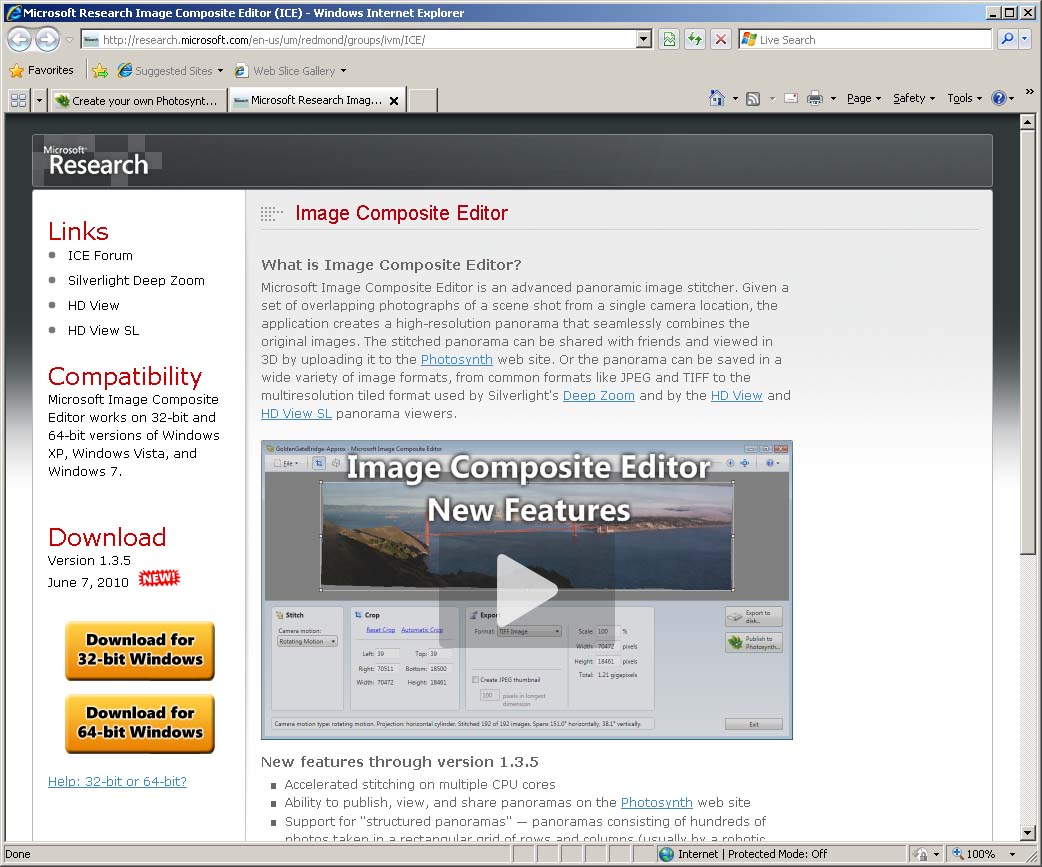
Microsoft ICE

I played with some 2 years back and I am a bit surprised it is still around, got more functions and it is still free to use. You can download it from
Of course, it is nicely embedded into the Microsoft landscape, it will work only on Windows and requires Silverlight and Photosynth if you want to publish the panorama on PhotoSynth. But you are still free to create panoramas and just save it to your harddisk.
  • Download it


  • Install and use it (simple workflow)


  • Optional download PhotoSynth and publish it


Remarks:
  • I usually dont like solutions that lock you to a specific framework or product, but ICE is a nice simple application with enough functionality for beginners and it allows to save you work as a separate file.
  • I dont know why the upload function forces you to upload the un-cropped panorama.
Test Result online:

Software and CPU Evolution (Part 2)

I digged out a panorama from Zurich in 2001 (earlier blog post). I remember well using Panorama Factory to stitch the 11 images (1600x1200 px, 1.9MP) and it took me more than 1 hour manually adjust the control points to get a OK result (plus a 30min stitching time). Today I took the same images and processed it in Autopano Pro in 25 seconds (incl. of opening the application, images, stitching and saving the panorama). 
Stitched 2001
Stitched 2010
Conclusion: We have great tools and crunching powerful CPU's that save valuable time. Lets go out and focus on shooting nice panoramas and dont race for the biggest Gigapixel image only !

Gigapixel Record Hunt

2 years back there were only few images on gigapan.org with a serious "big" resolution, now with the production release EPIC devices more highres panoramas are out there.
A bit longer breathtaking new super records of high resolution images come up every now and then.
Conclusion: We will see more of this kind coming up, and it is amazing at what detail level you can "zoom around" in these images. I recomend reading the technical background of the above projects, as you need serious project preparation, support (maybe some $$$) and serious CPU power. Guess I will stick to the "less-than-10 GP" department.

Remarks:
  • You find more gigapixel project if you research, some of them based on film (Gigapxl Project). Unfortunately some of the early projects are not online anymore.

Montag, 2. August 2010

Panorama Software advancing

I remember back 10 years (more or less) with few software applications around to stitch images. That was before Photoshop learned stitching and the time IPIX was running behind Prof. Dersch and his famous Panorama Tools. You had good results only with perfectly setup nodal point on a tripod, not to think of a handheld panorama without sometimes spending hours adjusting control points.
Now, you just throw any overlapping imagery into the actual versions of the software and you get decent results. Just a sample here, a panorama I tried to stitched 3 years back (handheld 7 images, 24mm) and put it into the "forget-it" folder. I took it out again and fed Autopano Pro 2.0.9 with it.
See some details of the result (all auto, stitched in less than 10min) compared with the 2 years old "auto-mode" stitch (the red squares are the detail from the old version):

Sonntag, 1. August 2010

My Digital Panoramas 2010

Fact 1: The market for panoramic prints is flat, you get average panoramic images everywhere and less customers are willing to pay a few hundred dollars for a large print (mounted or framed).
Fact 2: Same applies to virtual tours. I stick to existing customers but dont pursue actively new markets. It is not worth competing with 5$ per spot flatrate competition.

Conclusion: I do panoramic images for myself, continue to produce large prints for our house or anyone interested.

Plans: I just go through some unprocessed image material that accumulated over the last 2 years and finish some old projects. I have a Nodal-Ninja panorama-head that fits perfect to my Mamiya ZD to create outstanding resolution with few images. Guess I will restart posting here.

Digital Panorama 2010

Cameras: Panoramic Photography becomes mainstream, or at least the technology. More cameras are on the market creating panoramic views on the fly. Sony offers the Panorama Sweep mode, that allows literally sweeping over a scene and the camera creates a panoramic view on the spot. The quality is amazing but still cannot compete with "traditionally" stitched images and the camera still stitches discrete images and does not resemble a vertical line scanner. I wont buy one, but stick to my old Kodak V705 for on-the-spot panorama experiments.

Sony Alpha NEX-5 Digital Camera
(Picture by SHAFT9 on flickr)
See this sample panorama (link) or just serach for "sony nex 5 panorama" on flickr (it shows quite obvious stitching errors.

The result: you see panoramic images more often now, but similar to the flood of images when digital photography conquered the world in shape of mobile phones, it is hard to find outstanding panoramas.

Software: Panorama Stitching software keeps on evolving and we have CPU power and software (PTGui, Autopano,..) that creates panoramic images in much shorter time, even of not so perfect raw images. I re-visit old projects that failed some 2..3 years back in automode of Autopano and now get decent results ! On the expert-end more super-highres panoramas are released. Look at the 26 GigaPixel image of Paris, made of 2346 individual images (Dont think you can shoot that handheld!)

Montag, 26. Oktober 2009

Panobook 2009

The coffetable book published by Kolor is a yearbook with digital (stitched) images from the AutoPano Pro user community. The book was released earlier this year (they are already working on the 2010 book), 365 images by 221 users from all over the world give enough interesting to browse for quite a while. A nice addition (for 27 Euro, free shipping) to my panorama library. You can order it from Kolor only (www.kolor.com).

Montag, 19. Oktober 2009

On Panorama Software

Todays' Stitching Software is more powerful than ever before. A very evolutionary process created some tools or features and performance that one would not have expected some years back.

My personal history of software I used over the years (in sequence):
  • Panoweaver (Windows and Mac, fisheye only)
  • Panoramafactory (Windows only, flat)
  • Autopano Pro 1.x (Windows)
  • PTMac (MAC only, similar to PTGui)
  • PTGui (Windows and Mac, only reason to stop using it is the missing Linux version)
  • Autopano Pro 2.0 (Windows, MAC, Linux)
I dont compare the applications with each other because I was using them at different times and each software had its feature(s) that made me using it for a longer period and there was a reason to move on (at that time, it might be different situation today though).

VR/Fisheye based work:
I stopped using Panoweaver and moved to PTMac because PW was not very flexible and only perfectly leveled fisheye shots would turn into a good VR and it was expensive to update to newer versions. I moved on to PTGui because most of my workflow was on Windows not on MAC.

Flat panoramas:
I started with Panoramafactory which was the first (Windows) stitching software I found, that allowed at least a half decent automatic control point creation. It failed with large panoramas (memory problem). I moved on to Autopano Pro because the stitching results were better without major control point cleanup. I started using PTGui because I eventually used it for VR work and it does a really great job, even for very handheld'ish and uneven shots. I still use it on Windows, but I use Autopano Pro now (again) because it runs on Linux (and I am migrating my complete workflow to Linux now).

Today:
I upgraded to Autopano Pro 2.0 (at a update price of 39.- Euro) and started it using the last few days. An amazing improvement of performance and quality since the last time I used 1.4. Thanks to the Autopano Team for creating a tool that runs under Linux. I will post some real life examples and results the new few days. I am currently feeding Autopano Pro with Mamiya ZD files (adding to huge panorama files).

Autopano Pro Website: www.autopano.net


Mittwoch, 14. Oktober 2009

Wachenheim Walkabout

A visit home again opens the eyes for some unseen and ignored details, plus some "touristic" spots. I brought the Noblex to shoot some film panoramas, but the cold temperature scrambled the film roll while forwarding. So the LX3 worked as a backup, no problems with film.

Donnerstag, 20. August 2009

Panorama on the fly

The panorama feature is nothing new, lots of consumer camera have at least a panorama assistant or even a in-camera stitch feature, producing more or less good panoramas on the spot, most of the time at a rather low resolution due to the limited camera memory and processing power).
I didnt notice a complete new approach to this by Sony earlier this year (March 09). They released the DSC-HX1, the first camera with a panorama sweep mode, which means basically it creates a panoramic image while panning across a scene. Judge yourself with the review at dpreview.com which comes with details and sample panoramas. As usual I am tempted to play with it, but the price tag is too high for another gadget.

Montag, 20. Juli 2009

Spontaneous Walkabout

Just quitting some meaningless seminar early today and I was right in the mood to shoot some pictures. Lucky enough the trusty LX3 is always around.

Sonntag, 19. Juli 2009

Update Summer 2009

It has been a while since my last blog entry ! Didnt do much VR or large panoramas recently besides small commercial projects. The VR market is dead, with some folks offering one 1 VR spot for the price of 1 Mug of beer. I focus more on independent projects are just having fun. Will upload some of the backlog'd uncprocessed raw material soon.
My recent project with Whelock Properties in Singapore (link):