Sonntag, 1. August 2010

My Digital Panoramas 2010

Fact 1: The market for panoramic prints is flat, you get average panoramic images everywhere and less customers are willing to pay a few hundred dollars for a large print (mounted or framed).
Fact 2: Same applies to virtual tours. I stick to existing customers but dont pursue actively new markets. It is not worth competing with 5$ per spot flatrate competition.

Conclusion: I do panoramic images for myself, continue to produce large prints for our house or anyone interested.

Plans: I just go through some unprocessed image material that accumulated over the last 2 years and finish some old projects. I have a Nodal-Ninja panorama-head that fits perfect to my Mamiya ZD to create outstanding resolution with few images. Guess I will restart posting here.

Digital Panorama 2010

Cameras: Panoramic Photography becomes mainstream, or at least the technology. More cameras are on the market creating panoramic views on the fly. Sony offers the Panorama Sweep mode, that allows literally sweeping over a scene and the camera creates a panoramic view on the spot. The quality is amazing but still cannot compete with "traditionally" stitched images and the camera still stitches discrete images and does not resemble a vertical line scanner. I wont buy one, but stick to my old Kodak V705 for on-the-spot panorama experiments.

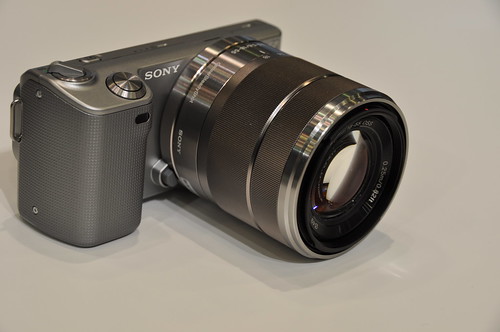
Sony Alpha NEX-5 Digital Camera
(Picture by SHAFT9 on flickr)
See this sample panorama (link) or just serach for "sony nex 5 panorama" on flickr (it shows quite obvious stitching errors.

The result: you see panoramic images more often now, but similar to the flood of images when digital photography conquered the world in shape of mobile phones, it is hard to find outstanding panoramas.

Software: Panorama Stitching software keeps on evolving and we have CPU power and software (PTGui, Autopano,..) that creates panoramic images in much shorter time, even of not so perfect raw images. I re-visit old projects that failed some 2..3 years back in automode of Autopano and now get decent results ! On the expert-end more super-highres panoramas are released. Look at the 26 GigaPixel image of Paris, made of 2346 individual images (Dont think you can shoot that handheld!)

Montag, 26. Oktober 2009

Panobook 2009

The coffetable book published by Kolor is a yearbook with digital (stitched) images from the AutoPano Pro user community. The book was released earlier this year (they are already working on the 2010 book), 365 images by 221 users from all over the world give enough interesting to browse for quite a while. A nice addition (for 27 Euro, free shipping) to my panorama library. You can order it from Kolor only (www.kolor.com).

Montag, 19. Oktober 2009

On Panorama Software

Todays' Stitching Software is more powerful than ever before. A very evolutionary process created some tools or features and performance that one would not have expected some years back.

My personal history of software I used over the years (in sequence):
  • Panoweaver (Windows and Mac, fisheye only)
  • Panoramafactory (Windows only, flat)
  • Autopano Pro 1.x (Windows)
  • PTMac (MAC only, similar to PTGui)
  • PTGui (Windows and Mac, only reason to stop using it is the missing Linux version)
  • Autopano Pro 2.0 (Windows, MAC, Linux)
I dont compare the applications with each other because I was using them at different times and each software had its feature(s) that made me using it for a longer period and there was a reason to move on (at that time, it might be different situation today though).

VR/Fisheye based work:
I stopped using Panoweaver and moved to PTMac because PW was not very flexible and only perfectly leveled fisheye shots would turn into a good VR and it was expensive to update to newer versions. I moved on to PTGui because most of my workflow was on Windows not on MAC.

Flat panoramas:
I started with Panoramafactory which was the first (Windows) stitching software I found, that allowed at least a half decent automatic control point creation. It failed with large panoramas (memory problem). I moved on to Autopano Pro because the stitching results were better without major control point cleanup. I started using PTGui because I eventually used it for VR work and it does a really great job, even for very handheld'ish and uneven shots. I still use it on Windows, but I use Autopano Pro now (again) because it runs on Linux (and I am migrating my complete workflow to Linux now).

Today:
I upgraded to Autopano Pro 2.0 (at a update price of 39.- Euro) and started it using the last few days. An amazing improvement of performance and quality since the last time I used 1.4. Thanks to the Autopano Team for creating a tool that runs under Linux. I will post some real life examples and results the new few days. I am currently feeding Autopano Pro with Mamiya ZD files (adding to huge panorama files).

Autopano Pro Website: www.autopano.net


Mittwoch, 14. Oktober 2009

Wachenheim Walkabout

A visit home again opens the eyes for some unseen and ignored details, plus some "touristic" spots. I brought the Noblex to shoot some film panoramas, but the cold temperature scrambled the film roll while forwarding. So the LX3 worked as a backup, no problems with film.

Donnerstag, 20. August 2009

Panorama on the fly

The panorama feature is nothing new, lots of consumer camera have at least a panorama assistant or even a in-camera stitch feature, producing more or less good panoramas on the spot, most of the time at a rather low resolution due to the limited camera memory and processing power).
I didnt notice a complete new approach to this by Sony earlier this year (March 09). They released the DSC-HX1, the first camera with a panorama sweep mode, which means basically it creates a panoramic image while panning across a scene. Judge yourself with the review at dpreview.com which comes with details and sample panoramas. As usual I am tempted to play with it, but the price tag is too high for another gadget.

Montag, 20. Juli 2009

Spontaneous Walkabout

Just quitting some meaningless seminar early today and I was right in the mood to shoot some pictures. Lucky enough the trusty LX3 is always around.

Sonntag, 19. Juli 2009

Update Summer 2009

It has been a while since my last blog entry ! Didnt do much VR or large panoramas recently besides small commercial projects. The VR market is dead, with some folks offering one 1 VR spot for the price of 1 Mug of beer. I focus more on independent projects are just having fun. Will upload some of the backlog'd uncprocessed raw material soon.
My recent project with Whelock Properties in Singapore (link):

Sonntag, 15. Februar 2009

Panorama Photography Generation Y (Z?)

Here we go.. Digital Panoramas are no longer a big deal. Even 7 year old kids can do it now with the help by Micorosofot..

Samstag, 7. Februar 2009

GIGAPAN production release

Have been a slow in producing panoramas lately and missed the fact that Gigapan Systems released their ex-prototype now as full production model with the name EPIC with only slight design changes (guessing from the look), also announced a EPIC 100 supposingly able to carry small DSLRS (D30 and others). Link to Gigapan Systems.
Picture copyright by Gigapan Systems

Aljunied Walkabout

Nice to see that some areas are not cleaned up yet and reflect a bit the old at look-and-feel of Singapore shophouses. In times of recession the pace of modernization should reduce hopefully.Walking the streets of Geylang and Aljunied with the LX3 in dynamic BW mode. The Panasonic is my mainly used camera at the moment.

Sonntag, 4. Januar 2009

VR with Mamiya ZD

A while ago I evaluated the user of the Mamiya ZD wich the 24mm lens (link) over the Canon 1Ds Sigma 8mm combo.

Facts 1Ds with Sigma 8mm:
3 or 4 images (4.062 x 2.704 pixel), fisheye
Resulting in a 5.000 x 2.500 equirectangular image.

Pro:
Full 360x180 degree coverage with 3 images.
Can be shot using monopod.

Con:
Lower resolution and image quality due to fisheye


Facts Mamiya ZD with ULD Sekor 24mm:
6 fullframe fishey images with 4.008 x 5.336 pixel each results

Resulting in a 16.500 x 5.200 equirectangular image.
Pro:
Crisp result, high resolution and quality image.

Con:
Requires shooting using tripod.
Does not cover zenith and nadir. Requires a sturdy panorama head with this gear, maybe Nodalninja 5, to shot up and down.

Sample: Stitched with PTGui 8.0.2 and converted to Flash with Pano2VR 2.2 beta4. Crop and Touchup Photoshop CS3.

Link to VR (flash based) version

Mittwoch, 10. Dezember 2008

Lunapark at night

At the last night in Sydney we did one more outing to a rather touristic spot, Luna Park (Wikipedia link) at Milsons Point nearby the Harbor Bridge (Wikipedia link). I let the Mamyia ZD run versus the LX3 and challenged them with this blue hour/night condition. Here the results of the Panasonic Lumix LX3. Quite convincing results, little noise for this small camera at night, specifically the dynamic bw mode, which I hardly touched in PS. ZD results will follow.

Montag, 1. Dezember 2008

Sydney 16:9 Walkabout

Exploring the city centre of Sydney with the Panasonic LX3 and looking for my favorite subjects: Walls, old facades, decay, doors, signs.